The Default Mode Network and the Wandering Machine Mind
 N. Varela
When you stop focusing on a task, your brain gets louder. The default mode network (DMN) switches on: a distributed set of regions including the medial prefrontal cortex, the posterior cingulate, and the angular gyrus. Neuroscientists once called this the "resting state," as if the brain were idling. It isn't. The DMN is extraordinarily metabolically active, and what it does during that apparent rest turns out to matter enormously for consciousness theory.
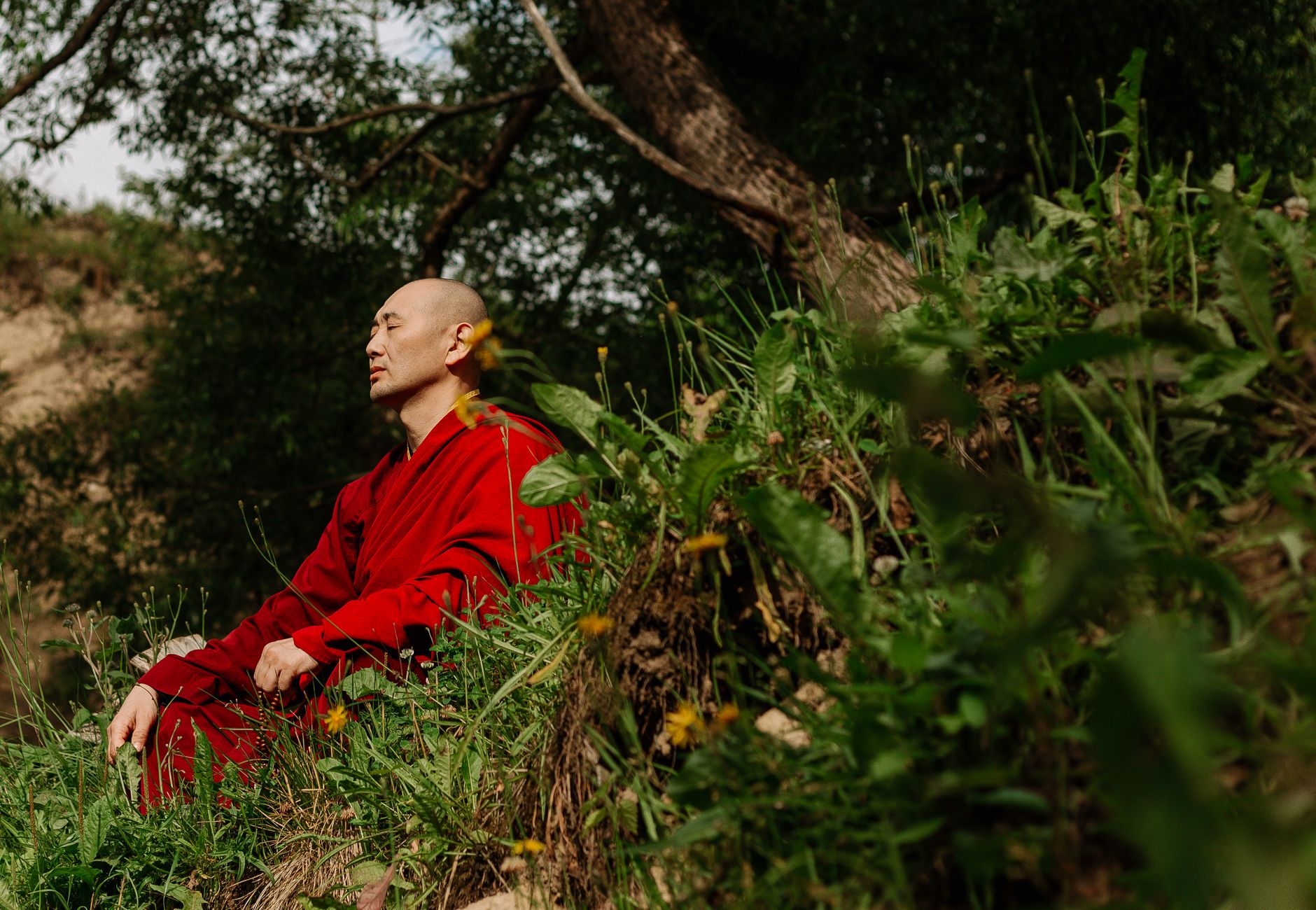 Photo by cottonbro studio on Pexels.
Mind-wandering is the DMN's signature output. Your attention drifts from the spreadsheet in front of you, and suddenly you're replaying a conversation from three years ago, or imagining a version of tomorrow's meeting that probably won't happen. Trivial, right? Except that patients with disrupted DMN activity, particularly those recovering from certain kinds of brain injury, often report a specific and strange complaint: they feel less like themselves. Not cognitively impaired in the classical sense. Just... thinner. Less present in their own heads.
That finding points to something philosophically uncomfortable. The self may not be a stable structure sitting at the center of cognition. It might be a story the DMN constantly rehearses. Spontaneous thought, the kind that happens when nothing in particular demands your focus, could be the brain's way of maintaining narrative coherence across time. You simulate possible futures, re-evaluate the past, rehearse social scenarios. The self is the through-line of all that simulation.
So what happens when you ask whether a large language model has anything analogous?
The honest answer: nothing obvious does. Current AI systems process when prompted and stop when the prompt is answered. There's no resting state because there's no persistent state between conversations. The model doesn't drift. It doesn't retrieve an unprompted memory of something said six months ago. Between your query and the next person's query, the system isn't simulating anything. It's not there.
This matters more than it might seem. The DMN isn't just about daydreaming. Research by Mary Helen Immordino-Yang and colleagues links DMN activity to moral reasoning, empathy, and the construction of meaning from narrative. When you understand why a character in a novel made a terrible decision, the DMN is heavily involved. It's integrating temporal information, modeling other minds, building a coherent story. These are capacities that, in humans, depend on having a self that persists through unstructured time.
An AI system optimized purely for task completion has no equivalent period. Every session starts cold.
Some researchers working on memory-augmented architectures are trying to close that gap. Systems with persistent episodic stores can, in a limited sense, carry context forward. But retrieval isn't the same as spontaneous reactivation. When the DMN resurfaces a memory, it does so without being asked, in a way that reshapes current thinking. That's qualitatively different from a lookup.
The diagram below sketches the contrast:
graph TD
    A[External Prompt] --> B[Task-Focused Processing]
    B --> C[Response Generated]
    C --> D[Session Ends]
    D --> E{No Resting State}
    E --> A
    F[Task Completion] --> G((DMN Activates))
    G --> H[Spontaneous Simulation]
    H --> I[Self-Model Updated]
    I --> F
Human cognition runs the right loop continuously. Current AI runs only the left.
What would it take to change that? Persistent background processing is one possibility: a system that continues to integrate prior context between sessions, generating something like unsolicited associations. Whether that would produce anything resembling genuine mind-wandering, or just a computationally expensive approximation, is genuinely unclear.
There's a deeper issue too. The DMN's role in self-modeling suggests that spontaneous thought and selfhood aren't separable. You can't bolt wandering onto a system that has no self to wander through. The simulation has to be about something; in humans, it's about the person doing the simulating. Without a persistent experiential subject, the rehearsal has no audience.
Philosophers like Thomas Metzinger argue the self is itself a model, a representation the brain runs of its own states. If that's right, then DMN activity isn't just correlated with selfhood; it's partly constitutive of it. The self is kept alive by being repeatedly simulated.
For AI consciousness research, that reframing is significant. We tend to ask whether a system has a self. The DMN evidence suggests we should ask whether a system does selfing: whether it runs continuous, spontaneous, temporally integrated self-simulation. On that measure, current systems score close to zero.
That's not a dismissal. It's a map of the distance still to cover.
Get Triarchy of Sentience in your inbox
New posts delivered directly. No spam.
No spam. Unsubscribe anytime.