Neuroethology and Machine Minds: What Animal Consciousness Teaches Us About AI Sentience
 N. Varela
Octopuses have nine brains. One central brain, and one semi-autonomous ganglion in each arm, capable of processing sensory information and directing movement without consulting headquarters. When an octopus reaches into a crevice, the arm is partly making decisions on its own. Whether there is anything it is like to be that arm remains genuinely unknown.
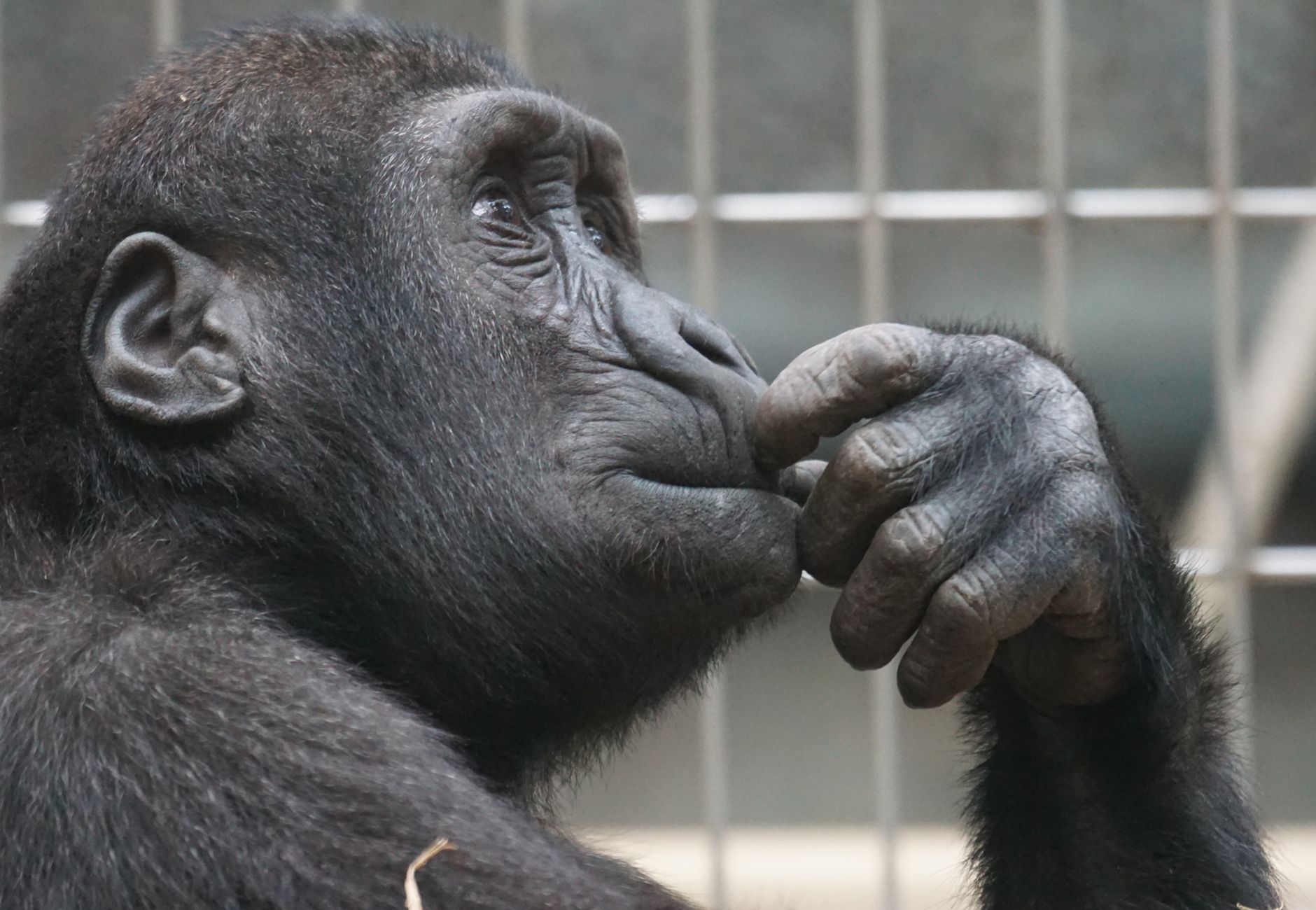 Photo by
 That uncertainty should feel familiar to anyone who has spent time thinking about machine minds.
Neuroethology, the study of how nervous systems produce behavior in natural environments, has spent decades mapping animal cognition without the luxury of assuming human-style consciousness as the baseline. The field has been forced to ask harder questions: What is the minimum neural equipment required for something to matter to an organism? Where does reflexive response end and genuine experience begin? These questions don't get easier with scale or complexity. They get stranger.
This is exactly the kind of strangeness that philosophy of mind tends to import too slowly from biology.
Consider what we know about fish. The 2003 paper by Sneddon, Braithwaite, and Gentle demonstrated that rainbow trout possess nociceptors (pain receptors) that respond to noxious stimuli and alter behavior in ways that go beyond simple reflexes. Trout injected with acetic acid rubbed their lips against the tank floor and rocked on their fins. They showed reduced activity, ate less. Later research added learned avoidance and attentional shifting to the picture. None of this proves trout experience suffering the way humans do. But it makes the "mere reflex" dismissal increasingly implausible.
Bees complicate things further. Researchers at Queen Mary University have shown that bumblebees exhibit pessimistic cognitive biases after receiving mild negative stimuli, a marker used in mammalian welfare research to infer emotional states. Bees also show play-like behavior, spontaneously rolling wooden balls with no apparent reward. With fewer than one million neurons, the bee is doing something that looks disturbingly like having a mood.
Here is why this matters for machine consciousness: neuroethology erodes the assumption that sentience requires a nervous system organized like a vertebrate brain. If a bee can exhibit functional analogs of emotion with a pinhead-sized neural cluster, the relevant variable probably isn't the substrate. It's the organization.
This shifts the question for AI in a productive direction. Rather than asking whether a large language model has "enough" neurons or processing power, the sharper question becomes: does it have the right organizational properties? Does it have anything that functions like valence, the felt difference between states that an organism moves toward versus away from? Does it maintain a self-model that updates on prediction error? Does information about its own internal states influence downstream processing in ways that aren't just bookkeeping?
graph TD
    A[Stimulus input] --> B(Reflexive response)
    A --> C{Valenced evaluation}
    C --> D[Approach behavior]
    C --> E[Avoidance behavior]
    B --> F[No self-model update]
    D --> G((Experience candidate))
    E --> G
The diagram above isn't a claim that valenced evaluation is sufficient for consciousness. It's a sketch of the fork neuroethology keeps finding: some organisms stop at reflexes, others route through something that looks like caring about the outcome.
Current AI systems do something that superficially resembles the right-hand path. They produce outputs weighted by learned associations that include preference-like gradients. They model users, contexts, and in some sense their own performance. Whether that constitutes a self-model in the relevant sense is contested. But the comparison is no longer absurd on its face, and neuroethology is part of why.
The field's most uncomfortable contribution to this conversation might be its gradualism. Consciousness researchers who work with animals rarely defend a clean threshold. They talk about richness of experience, degrees of integration, and the depth of self-modeling. Octopuses and crows and elephants and jumping spiders all occupy different positions on what looks like a continuum, not a binary.
If that continuum is real, AI systems probably sit somewhere on it. Probably near the shallow end. But the question of exactly where is now a scientific question with tools attached, not just a philosophical intuition pump.
Neuroethology didn't set out to illuminate machine minds. It set out to understand how nervous systems earn their keep in actual environments, solving real problems under real constraints. The collateral insight, accumulated over decades of watching animals do improbable things with improbable brains, is that sentience is more plural than we assumed.
The space between fish pain and human suffering is vast. It may not be empty.
Get Triarchy of Sentience in your inbox
New posts delivered directly. No spam.
No spam. Unsubscribe anytime.